Say Yes to Languages | Language Sampler Module 2022/23 | APPLY NOW

Last month, the Minister for Education, Norma Foley, announced an extension of the “Say Yes to Languages” primary languages sampler module for a further year and invited primary schools to apply to participate in the module.

The length of the module in 2022/23 will be increased from 6 to 8 weeks. The grant to schools participating will also be increased to €400 per class up to a maximum of €1,600.

The module is aimed at 3rd to 6th class and the school can select the language of choice depending on its demographic and school context.

The 2022/23 module could be used to support the integration of newly arrived Ukrainian pupils to our schools by acknowledging Ukrainian as one of the languages of the classroom or by choosing to teach Ukrainian for the duration of the module.


Photo: languagesconnect.ie


Languages selected in 21/22 included French, Spanish, ISL, German, Italian, Mandarin Chinese, Polish, Portuguese, Romanian, Arabic, Tamil and Portuguese.

The primary language sampler module can be delivered by either the class teacher in the school or by an individual identified by the school as a suitable tutor (for example, a language teacher/ foreign language assistant in a local post-primary school or a member of the community who is fluent in the chosen language, for example, a parent, who meets the scheme’s criteria).

Training for the teacher/ tutor will be provided by Post Primary Languages Ireland (PPLI) which will also provide all the necessary resources and supports to the schools delivering the module. Further information on the resources are available on the Post Primary Languages Ireland (PPLI) website.

Further details on the module are available in a circular.

How to apply: Schools can apply to participate in the module in 2022/23 here.

The closing date for receipt of completed application forms is 5pm on 11 May 2022.

Experience Japan 2022 | Join the celebrations of Hanami Festival!

Experience Japan festival will be returning to the wonderful Farmleigh House, Phoenix Park, Dublin on Sunday, 10th April to celebrate traditional Hanami or Cherry Blossom festival with lots of Japanese music and dance performances, martial arts, cosplay and kimono displays, delicious Japanese food, and demonstrations of Japanese culture and traditions.
All events are free and everybody is welcome!
The programme of Experience Japan festival has been published and it is packed with amazing events for everyone to enjoy! 
 
HOW TO GET THERE?

BUS

Dublin Bus Route 37 will drop you at Castleknock Gate (stop number 1669).

Enter Phoenix Park and take the narrow pedestrian path to your immediate right. Walk down this path until you reach the road, and turn right to see the gates of Farmleigh. This is about a 15 minute walk. On a rainy day, it may be muddy and a longer route along roads may be preferred.

CAR

Farmleigh is inside the Phoenix Park.  There are 300 free car spaces on site.

We encourage all festival goers to prioritise the parking needs of people with access or mobility issues, and take public transport wherever possible.

It will not be possible to park on White’s Road as Garda traffic restrictions will be in place. Please be wary of sat-nav! There is a 5-7 minute walk from Farmleigh car park to the House, Gallery and Gardens. Full driving directions are here.

BICYCLE

There are several Dublin Bike stations close to the shuttle bus stop on Parkgate Street.

***

Follow Experience Japan for more updates and news!
 

Japanese Film Festival (JFF) returns to Irish cinemas this April

The Japanese Film Festival returns for its 14th outing this April, bringing the best of Japanese cinema to audiences across Ireland.
This year, Ireland’s only truly national film festival returns to its usual April slot. Screenings will take place in seven venues nationally, starting in Cork on Sunday April 3rd. April 7th will see the start of screenings in Dublin, Galway and Waterford. The festival continues in Tipperary on April 9th and concludes in Dundalk on April 23rd.
From festival favourites and hidden gems to the latest anime and blockbuster hits, every year JFF aims to bring the best of contemporary Japanese cinema to Irish audiences – and this year is no different.
This year’s line-up includes Tokyo Revengers, a live-action adaptation of the hit manga / anime series and one of the biggest Japanese box office successes of 2021. Time travel, romance, yakuza drama, action – Tokyo Revengers has it all.
Under The Open Sky, meanwhile, is among the most acclaimed Japanese dramas of recent years, boasting a career-best lead performance from veteran star Koji Yakusho (The Eel, Shall We Dance?, Cure, 13 Assassins).

Photo: Under the Open Sky (JFF 2022)

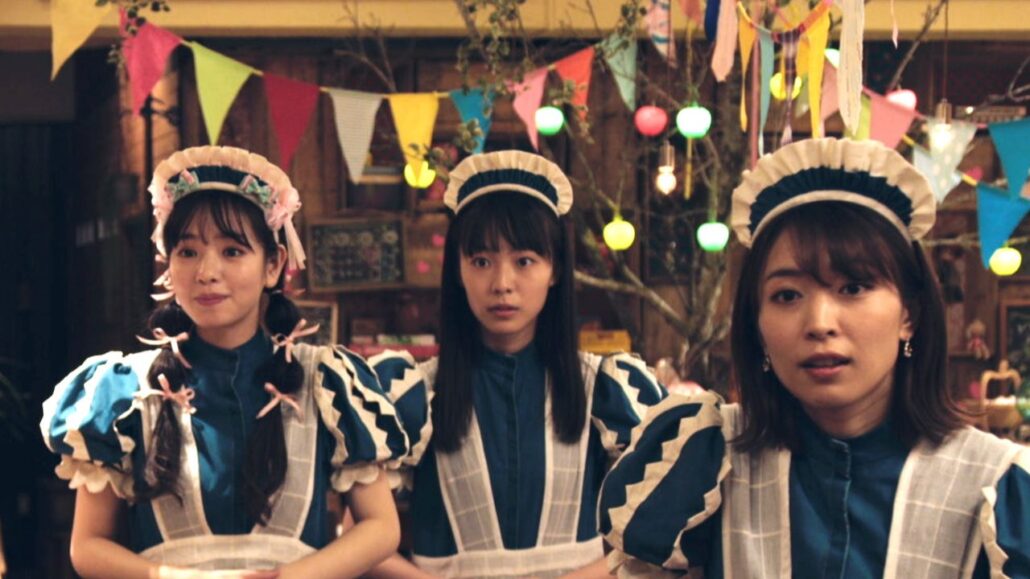
Other highlights at this year’s festival include Ito, a funny and poignant drama about a disaffected young woman who starts working in a maid café; Onoda: 10,000 Nights in the Jungle, a captivating take on one of the most unusual chapters of World War II and its aftermath; and Dawning on Us, a sharp social satire set in the immediate aftermath of lockdown. Foodies won’t want to miss the sumptuous The Pursuit of Perfection, a documentary that focuses on four of Japan’s most internationally celebrated chefs.

Photo: Ito (JFF 2022)

JFF 22 will also include the Irish premiere of the visionary stop-motion animation film Junk Head. Full of grotesque creatures, bizarre sights and unexpected comedy, Junk Head is an unforgettable trip into a subterranean sci-fi dystopia.

Photo: Junk Head (JFF 2022)

There’s something for everyone in this year’s anime selection. Looking for Magical Doremi is a lively and charming coming-of-age story and road trip across Japan. Sing a Bit of Harmony – the latest from Patema Inverted director Yasuhiro Yoshiura – is a joyous and energetic mix of high school drama, sci-fi and musical. Pompo the Cinephile brings a larger-than-life manga character to life while serving as a celebration of all things cinema. Last year’s JFF included the first Irish screenings of the Oscar-nominated Drive My Car.
JFF audiences in Cork, Galway and Waterford will this year have a chance to see director Ryusuke Hamaguchi’s other 2021 masterpiece – the extraordinary anthology film Wheel of Fortune & Fantasy – on the big screen.
TICKETING
Ticket sales information for screenings are available from each participating venue.
Ticketing links and listings are also available at www.jff.ie
JFF 2022 FULL FESTIVAL SCHEDULE
Gate Cinema, Cork
Sunday April 3rd to Wednesday April 6th
April 3 @ 18:00: Under The Open Sky
April 4 @ 18:00: Tokyo Revengers
April 5 @ 18:00: Pompo the Cinephile
April 6 @ 18:00: Ito
Triskel Arts Centre, Cork
Thursday April 7th
April 7 @ 18:00: The Pursuit of Perfection
April 7 @ 20:15: Wheel of Fortune & Fantasy
Light House Cinema, Dublin
Thursday April 7th to Thursday April 14th
April 7 @ 20:15: Under the Open Sky
April 8 @ 18:30: The Pursuit of Perfection
April 8 @ 20:15: Tokyo Revengers
April 9 @ 13:15: Looking for Magical Doremi
April 9 @ 15:00: Sing a Bit of Harmony
April 9 @ 18:30: Pompo the Cinephile
April 9 @ 20:15: Junk Head
April 10 @ 19:00: Onoda: 10,000 Nights in the Jungle
April 11 @ 18:00: Ito
April 12 @ 18:00: Dawning on Us
April 13 @ 18:00: The Murders of Oiso
April 14 @ 18:00: The Asadas!
Pálás Cinema, Galway
Thursday April 7th to Monday April 11th
April 7 @ 20:30: Under the Open Sky
April 8 @ 18:45: The Pursuit of Perfection
April 8 @ 20:30: Ito
April 9 @ 14:45: Looking for Magical Doremi
April 9 @ 16:30: Sing a Bit of Harmony
April 9 @ 18:45: Pompo the Cinephile
April 9 @ 20:30: Tokyo Revengers
April 10 @ 14:00: Dawning on Us
April 10 @ 16:30: Onoda: 10,000 Nights in the Jungle
April 10 @ 20:00: Wheel of Fortune & Fantasy
April 10 @ 18:30: Wheel of Fortune & Fantasy
Garter Lane Theatre, Waterford
Thursday April 7th to Saturday April 9th
April 7 @ 19:30: Sing of a Bit of Harmony
April 8 @ 19:30: Wheel of Fortune & Fantasy
April 9 @ 19:30: Pompo the Cinephile
Tipperary Excel Centre, Tipperary
Saturday April 9th
April 9th @ TBC: Sing a Bit of Harmony
An Táin Arts Centre, Dundalk
Saturday April 23rd
April 23rd @ TBC: Looking for Magical Doremi
April 23rd @ TBC: Summer Ghost + Making Of
April 23rd @ TBC: Pompo the Cinephile
***
Japanese Film Festival 2022 is co-organised by The Embassy of Japan and access>CINEMA.

IJA Annual General Meeting 2022 | Review

The 32nd Annual General Meeting for the Ireland Japan Association took place on Thursday, 24th March 2022. Meeting was held as a hybrid event with members attending in person and remotely via Zoom platform.

Raymond Hegarty, IJA Chairperson, thanked the outgoing Council members for their work, participation and team effort throughout the past year, Embassy of Japan for their continued support to the IJA, and all IJA Corporate and Individual members who have supported association and its activities in 2021.

Raymond Hegarty paid his respects to the late Derek Ryan, founder of Yamamori Japanese restaurants in Dublin. Yamamori has been a Corporate Member of the IJA and supporter of the IJA events for years.

In his report, Raymond Hegarty noted that 12 business and culture events were organized online and in person throughout the past year, including IJA Japanese Conversation Group, AGM 2021, Online Book Launch: Black Dragonfly by Jean Pasley, Sake Tasting Night, Origami workshop, Mid-Summer Japanese Outdoor Event, Tokyo Olympics: The Countdown, IJA Golf Outing 2021, Placing Employee Wellness at the Heart of Your Organisational Culture, tickets for the IJA members to the Ireland vs Japan Rugby Match at Aviva Stadium, Business Opportunities in Changing World, and Bounenkai Sake Reception and Dinner.

In 2021 IJA supported and promoted a list of online events organized by the IJA partner organisations, members and friends UCD Japan, Unique Japan Tours, the Ireland Japan Chamber of Commerce, Writers of Kyoto, Chester Beatty, Lafcadio Hearn Japanese Gardens in Tramore, and many more.

The IJA supported Japanese School of Ireland with a donations in 2021.

Raymond Hegarty informed that IJA member’s network had 35 corporate members and 58 individual members in 2021. Two new corporate members joined the IJA in 2021 – VIOTAS and Shikkui Ireland.

An update on the Dr. and Mrs. Ushioda Scholarship was given during the meeting. Raymond Hegarty informed that after pausing scholarship award in 2020 due to Covid pandemic, in 2021 the IJA was honoured to award it to Francis Donnelly, studying for BA in Applied Languages, University of Limerick. Francis is planning to go to Nagoya University of Foreign Studies to continue her Japanese studies abroad. Raymond Hegarty thanked Paula Kelly for her support and assistance with the scholarship management and administration process over the last year.

Summary of the IJA Financial Statements for 2021 was shared with the AGM participants, membership subscription fees were discussed and approved for 2022/2023 and the new IJA Council members were announced.

Raymond Hegarty informed that this year there are 2 Council members leaving the Council. He thanked Verity Swan and Hiroaki Ozaki for their valuable advice, work and participation during their time on the Council. Yasuyuki Ozeki, former IJA Vice Chairperson will continue his work on the Council as an Ordinary Council member.

This year the IJA received enough nominations to satisfy the constitutional requirements for Chairperson and Ordinary Council members, and all places were filled without requiring a vote. This year 2 nominations were received for the IJA Vice Chairperson seat and voting took place from Thursday, 10th March – Thursday, 17th March 2022. Election results were reviewed and confirmed by an independent assessor – Stephen Power, Power & Associates.

We are delighted to announce that the new IJA Vice Chairperson is Tsugumi Yamamoto, IJA Individual member. We would also like to thank other nominee Hiro Ino, IJA Individual member, who will continue his work on the Council as an Ordinary Council member.

Four new Council members were welcomed to the IJA Council this year – Tsugumi Yamamoto, IJA Individual member who will take the seat of the IJA Vice Chairperson, and Brian Marconi, JTI, Hiro Ino, IJA Individual member and Jonathan Kelly, IJA Individual member who all will join the Council as Ordinary members.

The newly elected IJA Council for 2022:

Chairperson, Vice-Chairperson

  1. Raymond Hegarty, IJA Individual Member (Chairperson)
  2. Tsugumi Yamamoto, IJA Individual Member (Vice Chairperson)

Corporate Members:

  1. Brian Marconi, JTI
  2. Catherine Grennell-Whyte, Finnair/ATTS
  3. Darina Slattery, Unique Japan Tours
  4. Laura Goonan, Dillon Eustace
  5. Pamela Connell, Bank of Ireland Corporate Banking
  6. Stephen Mullin, CPL Ireland
  7. Yasuyuki Ozeki, JETRO

Individual Members:

  1. Eddie Hughes, IJA Individual Member
  2. Hiro Ino, IJA Individual Member
  3. Jonathan Kelly, IJA Individual Member
  4. Paula Kelly, IJA Individual Member

Not on Council but invited to attend meetings:

  1. Sou Watanabe (Honorary Member)


Experience Japan festival returns to Phoenix Park on 10th April

Long awaited and good news from our friends at Experience Japan – it has been confirmed that Experience Japan festival will be returning to the wonderful Farmleigh house and estate this spring.
The festival takes its name from ‘Hanami’: the traditional Japanese custom of viewing flowers, especially cherry blossoms, to mark the arrival of Spring. Each year Experience Japan brings families and friends together in the beautiful setting of Farmleigh in the Phoenix Park, to enjoy music and dance performances, martial arts demonstrations, seminars, and a variety of traditional arts and crafts, and to discover Japanese culture, including lots of delicious Japanese food. Many festival-goers dress for the occasion: in traditional styles, following Japanese fashion subcultures, or in cosplay.
Festival organisers will look forward to welcoming you at this year’s Hanami Festival on Sunday, 10th April.
Festival team also is looking for volunteers who could help at the festival. Volunteers are invited to complete the application form to register as a volunteer for the 2022 festival. Any questions can be emailed to volunteers.experiencejapan@gmail.com
For more information and letest updates, please check Experience Japan website:

JLTI Language Contest 2022 | Applications Open

IMPORTANT: Application deadline has been extended until Monday, 14th March 2022!
The Japanese Language Contest 2022 is open for entries.
This year’s theme is ‘Time for Fun’, contest will take place online, and you can send entries in the form of speech or Japanese language soundtrack videos which demonstrate a fun outlook.
The entries will be evaluated on a variety of criteria such as language level and expression, creativity and performance, and the prizes will reward a range of different styles, abilities and effort. The judging panel will take into account the language background and learning experience of the entrants which will be documented through their application forms.
Applications are accepted in 2 categories:
  • Secondary School Category A & B (A: TY& 5th year, B: 6th year) – individuals
    • Video clip of a self-introduction speech
    • One individual speaker should be clearly shown making their speech on screen.
    • No use of special props or items, other speaker or background noise or music etc is permitted.
    • Duration is 1 – 5 minutes
  • Open Category – individuals or groups
    • It can be individual or group production
    • Open format; (i.e.) speech, conversation, skit, drama, song, poetry, show & tell, presentation or animation
    • There must be a soundtrack in Japanese voiced by the entrant(s)
    • If entrants are not shown speaking on screen, then a separate short video must be provided with the application form which clearly shows the entrant(s) giving their names and speaking the lines. This video will not be evaluated for judging purposes.
    • Duration is 2 – 7 minutes

CRITERIA FOR PARTICIPATION

  • Participants must not be Japanese native speakers
  • Participants must be residents of Ireland.
  • Secondary School Category: This category is open to individual entrants of Secondary School age only.
  • Open Category: Participants cannot have lived in Japan for longer than 5 years in total. This category is open to entrants of all ages.
  • Neither participants themselves nor their immediate family members may be members of the JLTI.
  • Only one entry per category per person, regardless of whether individual or part of a group.
  • Participants should submit the application form including their YouTube video link and consent form(s) by the deadline.
  • A signed consent form must be provided for each member of any team entries for the Open Category.
  • For individual entries, the file names for the YouTube Videos and Consent Form should include the name of the entrant. The group name should be included in the file names for group entry videos and group member consent forms.
  • Applications will be accepted until March 7th.

APPLICATION DEADLINE IS MONDAY, 7 MARCH 2022.

Results will be announced by the end of March.

The winners will be added to our website and winning entries will be showcased on social media.

For information, application forms and guidelines, please visit JLTI website: https://jlti.org/jp/speech/
***

Contest is hosted by Japanese Language Teachers of Ireland (JLTI) and The Embassy of Japan in Ireland. Supported by the Japan Foundation. Sponsor: PPLI.

Book Review: Structures of Kyoto: Writers in Kyoto Anthology 4 | Review by Jean Pasley

My first thought on reading Structures of Kyoto (Writers in Kyoto Anthology 4) was that I must go back to Kyoto. I have visited the city many times, lived there for months on end, and this book reminded me of what a special place it is and how much I miss it. It also alerted me to how much I missed while I was there. In this anthology, writers share their insights, knowledge and experiences of life in Kyoto, from the sublime tea ceremony to the other extreme: a school trophy made out of a rubber duck taped to a plastic plinth. There is something here for everyone.

The wonderful title of Mark Hovane’s essay, Rocks, Gravel and a bit of Moss, gives a sense of playfulness that belies the erudite content of this excellent essay and indeed of the entire anthology.

Did you know that Ryoanji is the second most photographed garden in the world? No? Neither did I.

I expect there is much I don’t know about Zen gardens. Hovane writes, “Knowing historically that these spaces are, on one level, 3D representations of 2D Chinese ink paintings is a good place to start” your study of these enigmatic spaces.

Reggie Pawle recalls a monk telling him that “Zen practice is like tying yourself up with a rope and then, in that condition, finding your freedom.” It seems that the harder you try to understand Zen the more elusive it becomes. Pawle says you learn “by doing rather than by analytically figuring things out.” His essay offers an amusing glimpse into the bewildering concept of Zen.

It is interesting how you can live somewhere and remain oblivious to the significance of what you are seeing all around you.

How many times have I walked past five-tiered tower-like structures without realising the profound importance of them? These are gorinto and they are “primarily associated with memorialising the dead.” In Jann Williams’ intriguing and informative essay, Beyond Zen – Kyoto’s Gorinto Connections, I learned that the five geometric shapes stacked on top of one another that form the structure of gorinto are the cube, sphere, triangle, semi-circle and jewel. The five shapes represent the elements of the universe: earth, water, fire, wind and space and they embody the interconnectedness of all creation. The next time I see gorinto, I will pay more attention.


It was in November 2012 that Jann Williams first experienced gorinto at Adashino Nenbutsuji, a small Pure land Temple in northern Arashiyama, Kyoto. She was deeply moved by their form, beauty, spiritual connectedness and energy.

Gorinto Siddham, Higashi Otani (photo: Jann Williams)


Catherine Pawasarat writes about how she spent untold hours at the annual Gion Festival before she started delving into the understated rituals taking place. She asks the question: “How can we humans long so deeply for significance in our lives and be blind to it at the same time?” Pawasarat explains the gruesome origins of this spectacular thousand-year-old festival during which the main deities, the god of storms and the goddess of rice, are welcomed every year to purify the city and its inhabitants.


Tradition holds that the spectacular Gion Festival floats purify the city streets in preparation for the Yasaka Shrine deities to bless central Kyoto, protecting its people from epidemics and other harm. (photo: Catherine Pawasarat)

The Gion Festival’s Ennogyoja Yama celebrates the 7th-century founder of Shugendo. This nature-mystic Buddhist path is followed by practitioners called Yamabushi, shown accompanying the float here. (photo: Catherine Pawasarat)


This book contains many little gems and nuggets of wisdom. Did you know that monks used to use green tea to help them stay awake during long periods of meditation, or that the sound of an iron kettle boiling on the charcoal brazier in the teahouse creates a whispering sound known as matsukaze, wind in the pines?

Apparently, “a ladleful of cold water poured into the kettle causes this sound to cease and creates a moment of utter silence and peace.” This, Rebecca Otowa tells us in Structures of Tea, is “one of the many wordless moments in tea ceremony that have the power to lift one out of ordinary sensation.”

There is another side to life in Kyoto. In Ina Sanjana’s heartfelt piece, Sunrise over the Kamogawa, we feel the loneliness of a homeless man, who “would like to hear someone say his name. Even in contempt.” And in Karen Lee Tawarayama’s science fiction set in 2050, The Life Dispensary, the summer heat has become unbearable not just for humans but for other bewildered creatures who are forced to take refuge in ponds, springs and rivers. This sad story highlights the climate crisis and a possible future intensifying of the sweltering heat that Kyoto already suffers during the summer months.

The unique landscape in and around Kyoto is depicted beautifully. Travel with Edward J. Taylor on a winter’s day to the village of Ohara where he hopes to walk “through fields of snow, the white purifying valley, called the Pure Land.” Stay with him through an area of “small forest between two massive beds of moss from which small jizo statues sprout like mushrooms.” Or enjoy John Einarsen’s elegant piece about the Dragon Gate of the World. “It stands alone atop wide stone steps, its three doorways always open to a forest, and beyond, mountains, keeping nothing in nor anything out.” The forest is “wild and free and vast beyond imagining.”


Nanzen-ji Sanmon (photo: John Einarsen)


Vast beyond imagining, as is Kyoto, a city where the secular world and the spiritual world stand side by side. During Obon, the annual Festival of the Dead, the souls of the ancestors return to visit their families. At the end of the three-day festival huge bonfires are lit on the surrounding mountains to guide the spirits back to the heavens. The fires can be seen all over the city.  In Lisa Wilcut’s beautiful poem, Okuribi, two recently bereaved people stand on their hotel roof and toast a departing spirit while gazing at the fires burning in the distance; “the spirits almost palpable in the haze that hovers over the city.”

Structures of Kyoto Anthology 4 is an eclectic mix of things personal, poetic, aesthetic, magical, modern and ancient, gathered together in an informative, thought-provoking collection. Enhanced with photographs and illustrations, this is a delightful book to dip in and out of.

It will amuse, inform and move you, whether you live in Kyoto, are simply passing through, or are dreaming about this ancient city from the other side of the world.

***

Award-winning writer/director Jean Pasley lived in Japan for many years. Her debut novel Black Dragonfly was published in 2021.  Set in late nineteenth century Japan, it is a historical novel based on the remarkable experiences of the Irish writer, Lafcadio Hearn.


More information about the book can be found – here!

Order your copy of ‘Structures of Kyoto: Writers in Kyoto Anthology 4’ (2021) – here!


IJA Bounenkai End of Year Party 2021 | Photo Gallery

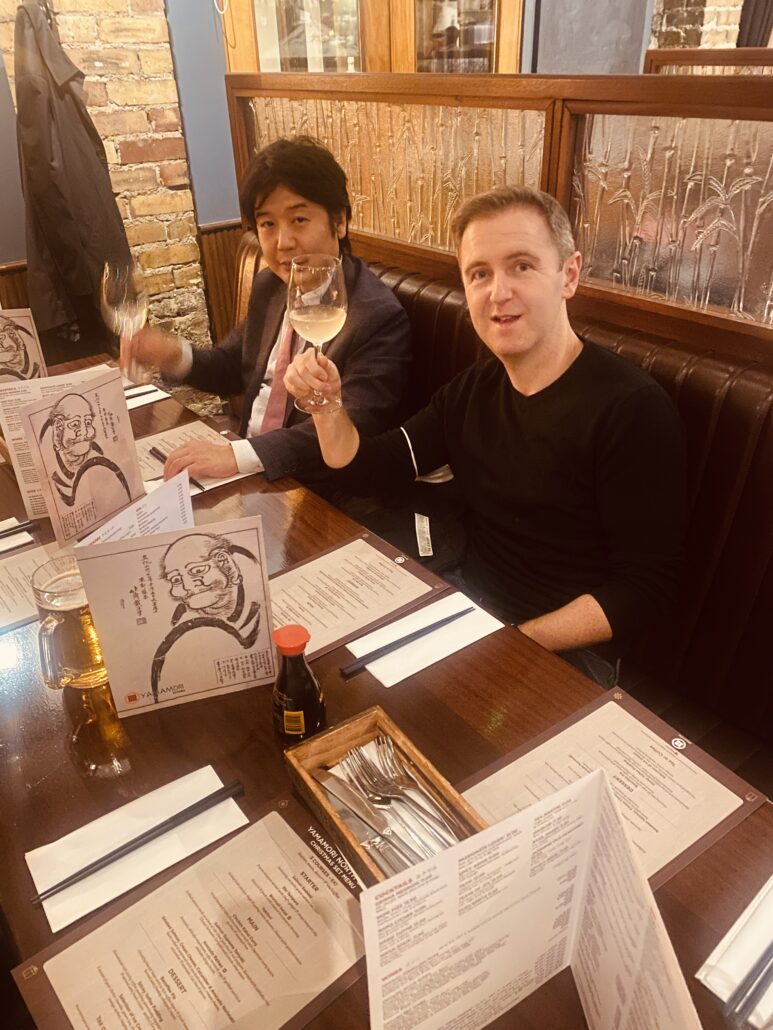
On 2nd December the IJA members, friends, and supporters came together to celebrate and enjoy one of the most exciting cultural events and celebrations of the year – IJA Bounenkai End of Year Party with Sake reception and delicious Japanese dinner taking place at Yamamori Sushi, Dublin.

Eddie Hughes, IJA Council, welcomed everyone to the event and shared a message from Raymond Hegarty, IJA Chairperson:

Bounenkai – the Japanese traditional year end party is a way to close off the year with friends and colleagues and get ready to welcome a new year. The word Bounenkai literally means ‘a gathering to forget the year’ – to put the troubles of the year behind you and face the future.

This echoes traditional celebrations dating back to 16th century Japan, when the Samurai lords would gather in late December for a day of cultural activities such as writing and reciting poetry. In the evening they would celebrate with a large banquet.

We do not expect much poetry to be written tonight, but we do hope that you enjoy each other’s company at the sake reception and during the meal.

Thank you for supporting the IJA this year. I wish you all the best for this evening and for the end of the year. I look forward to seeing you all again in 2022. – Raymond Hegarty, IJA Chairperson

Colly Murray, RetroVino

Event guests had a wonderful opportunity to taste traditional Japanese Sake drinks, including premium Junmai Sake, accompanied by a short presentation on Sake history and culture by Colly Murray, RetroVino followed by a delicious dinner at Yamamori Sushi restaurant.
We would like to thank everyone  – our individual and corporate members as well as friends and supporters who attended this event. We appreciate your continued support to the IJA throughout this year.
A very big thanks goes to Colly Murray, RetroVino, for sharing his passion and knowledge about Japanese Sake, to Graham Ryan and his team, Yamamori Restaurants, for hosting our event and making sure everyone had the best time, and last but not least – to Eddie Hughes, IJA Council, for his time, support and help to make this event such a great success.

Note: Please note that during this event the IJA followed and complied with the health and safety recommendations and restaurant policy.

Photos: Eddie Hughes

EU-Japan News | December 2021 Issue Available Now

EU-Japan NEWS is the quarterly newsletter of the EU-Japan Centre launched in 2003 and containing EU-Japan-related news and features on topics of interest to EU and Japan businesses and public bodies.

The newest issue of the December 2021 Newsletter is available in an online and PDF version packed with the EU and Japan related news, partnering opportunities, network news and lots of other useful information and links.


EU-Japan Centre for Industrial Cooperation is a unique venture between the European Commission and the Japanese government. It is a non-profit organisation established as an affiliate of the Institute of International Studies and Training (IIST). It aims at promoting all forms of industrial, trade and investment cooperation between the EU and Japan and at improving EU and Japanese companies’ competitiveness and cooperation by facilitating exchanges of experience and know-how between EU and Japanese businesses.


You can read full December 2021 Newsletter online here!

You can read full December 2021 Newsletter in PDF format here!

Intercontinental ‘travels’ with my Granny’s postcards by Hew Prendergast

The early life of my Granny interested me for two main reasons. The first of them may soon facilitate my going abroad in a way I never once thought necessary. The second has already taken me via online ‘travels’ to countries far and wide. Despite much fascinating research involving medical education, international exhibitions in late nineteenth century Europe and the design of Japanese postage stamps, I still however cannot quite explain all the intercontinental links, let alone the manner in which I first came across them. In reading through this tale that starts with my Granny and stretches even to Brexit, perhaps a reader or two can throw some new light on these links, or discover lost nuances in translations from the Japanese that appear later.

My Granny was born in Dublin to the St Legers, a family of Norman and Anglo-Irish descent based for long in Co. Cork. If the name is somehow familiar it is perhaps through the eponymous horse race at Doncaster, the oldest Classic of the English flat-racing season; or, less likely, through the portrait of one John Hayes St Leger by Thomas Gainsborough that hangs at Buckingham Palace.
In the summer term of 1908 my Granny was 15, a pupil at the long-gone St Margaret’s Hall school on Mespil Road by Dublin’s Grand Canal. With an accomplishment unknown, much later, to her own grandchildren, she won as a prize for Theory of Music (so states a label inside the front cover) an undated gilt-edged edition of Elizabeth’s Barrett Browning’s Poetical Works. Its ‘prefatory memoir’ records the death of Elizabeth in 1861 when living in Florence with her poet husband Robert, and it reproduces words – in the tablet in the church where she is buried – the memory of “her golden verse linking Italy to England.”

My Granny has also long since died, spending most of her life in rural Co. Wexford, some of it in India, none in Italy and, as far as I know, showing no lasting interest in poetry. When I recently opened her prize book for the very first time I was in the process of sieving through passed-down belongings to decide what to keep and what not to, spurred on by the possibility of unearthing some forgotten gem or past family episode. But when, overleaf from the title page, three postcards came tumbling out, my surprise was as great as discovering my Granny’s putative poetic past. And so my ‘travels’ began.

The first card was easy enough to decipher. Alongside a stamp depicting George Washington were the boldly printed words ‘United States of America’, a rather faint St Louis postmark and an even fainter date of Jan. 7 1895. As if to confirm that my then just two year old Granny was not the recipient, the addressee was a Dr T.J. Chidley of 205 Great Brunswick (now republican Pearse) Street in Dublin whose western end runs past Trinity College. Dr Chidley, I knew, was no relation. However, the Boxwell family into which my Granny married in 1913 had in turn married into the Stokes family – and both of these produced lines of eminent medical doctors educated and working in Dublin. One Boxwell, Indian-born William, was President of the Royal College of Physicians of Ireland between 1937 and 1940; in the Stokes family, both also Williams, one succeeded his father in 1845 to become became Regius Professor of Physic at the University of Dublin while his own son in turn served as President of the Royal College of Surgeons in Ireland in 1886–1887.

The card sent to Dr Chidley from St Louis, Missouri.

Born in Glasnevin in 1862, Chidley registered for medical studies at Trinity College in 1885. Though these took place in Dublin, his qualifications were awarded under the aegis of the Royal Colleges of Physicians and Surgeons of Edinburgh and the Faculty of Physicians and Surgeons of Glasgow. The detailed entry in his Schedule for the Course of Study held in Edinburgh provided, I hoped, some sort of direct, explanatory link with my Granny’s medical relations. There, on the very last page and for his last year (1894), his teacher for the practice of surgery and operations is given as William Stokes, her uncle. One may easily imagine the physical act of Chidley handing over the postcard to Stokes, and thus into the wider family, but why would he do so?

The answer may lie in the advertisement on the other side of the card describing the virtues of antikamnia (meaning “opposed to pain”) and codeine tablets, a “combination particularly useful in La Grippe, Influenza and all Grippal conditions, Pneumonia, Bronchitis, Deep Seated Coughs, Neuroses of the Larynx, Etc, Etc.” The British and Colonial Agent for the tablets was given as a John Morgan Richards of Holborn Viaduct in London. Unusual for searches online, almost all mine for antikamnia homed in on just a single subject, the Antikamnia Chemical Company founded in 1890 in St Louis. In the long run its products actually proved fatal but that did not stop it making huge profits through – as the Wikipedia entry puts it – “clever advertising and marketing of the product targeting physicians, using physician testimonials and finding loopholes in the Pure Food and Drug Act of 1906.” This approach rings bells, seeming remarkably similar to that taken by Purdue Pharma in the USA, recently forced into bankruptcy over the opioid painkiller OxyContin, implicated in the deaths of hundreds of thousands. One could scarcely blame the newly graduated Chidley if he had indeed approached his most recent teacher for advice on such a dubious remedy in his own time.

None of this, however, makes any sense of the other two postcards whose hand-writing looked to me either Chinese or Japanese. What pointed to the latter was a minute Roman-scripted ‘Japanese Post’ on the printed stamp of one of the cards. How would I get any further on how they reached my Granny? A friend in Australia put me in touch with a professor of Japanese but, as she turned out to be too busy, I tried online with a site offering and looking for jobs. For the brief of translating the two postcards, offers and quotes poured in from countries across the globe but it was the solitary one from Japan itself that caught my eye. Kent, it later transpired, despite his fluency in English, had no idea until I told him that he shared a name with an English county but it was the sort of exchange that allowed a good relationship to build up between us. In the end he became an ally in trying to help me source the two cards.

But first he had to translate them. This was not easy. It was not due, he said, to the hand-written script which was clear enough but to its profound differences from the modern Japanese writing system. Kent struggled (“most of us don’t understand this at all”) and sought advice but eventually came back with the translations. What they revealed in the end brought me no nearer to any firm answer about their acquisition by my Granny but rather drew me into reading about aspects of Japanese culture and that country’s nineteenth century interactions with the West. The little I already knew stemmed from having curated, some years before, a collection of lacquerware that had been commissioned by the Royal Botanic Gardens, Kew in London. It had been made by John Quin, a member of the British Legation in Japan who, like so many of his peers at the time, was Irish. He had arrived in 1869 as a new recruit with the rank of 3rd Class Assistant and by 1888 had risen to become Consul in Nagasaki. Ill-health brought him back to Dublin where he died in 1897 and was buried in South Dublin’s Dean’s Grange Cemetery. The interest in lacquerware and the source tree of its resin exemplifies the European fascination with all things Japanese (japonisme) at the time – an interest that was reciprocated in full but how does it fit into the tale of these postcards?

The Japanese Post card, its design and 1 Sen denomination dating it (so I am told) to between 1885 and 1899, was written by a Mr Chobei Okamoto in Bessho Village, Otsu (a port on Lake Biwa) to Mr Shuzo Kumimara, a kimono dealer in Bungo Bashi-cho, Fushimi ward in the former imperial capital of Kyoto about 20 kilometres away. “Dear Sir,” it begins, “Please pardon my intrusion. As per my requests sent recently via Tsuji Yasaburō and the lady of the Hishikawa household, I am very keen for you to sell to me your Omoto [Japanese sacred lily] net cupboard. The fact is that I will soon be establishing a branch of Suruga-ya in Ōtsu, and intend to sell Yōkan [sweet bean cakes] there. That is why I want your net cupboard, for Suruga-ya. That is the situation, so I apologize for being so forward, but I hope you can comply with my request. As for the price, I will ensure there is some profit above whatever price you paid for it, so please sell it to me. Thank you in anticipation.

P.S. Sorry for the trouble, but I would appreciate it if you can let me know as soon as you have received this postcard.”

The postcard from Mr Chobei Okamoto to Mr Shuzo Kumimara

No trace has emerged of the kimono dealer but Mr Okamoto’s yokan-making enterprise not only has a well-documented heritage back to 1461 – and is widely listed as one of the world’s oldest commercial enterprises – but is still run by its founding family. Suruga-ya’s survival of a temporary closure in 2014 was even referred to in a Wall Street Journal report on the impact of Prime Minister Shinzo Abe’s economic policies. It now operates in Wakayama, about 100 kilometres south west of Kyoto, under the presidency of Mr Ryota Okamoto, the 23rd member of the family to do so. The company’s own website states that his ancestor Chobei went to the 1878 Exposition Universelle (World Fair) in Paris but I could get no further with discovering if he had also gone to later exhibitions. Perhaps I would have more luck with the second card which, as it turned out, points to such exhibitions as possible routes for these cards to have reached Europe.

This one was sent on 1 January of the 33rd year after the Meiji restoration of imperial rule, thus 1900. It is addressed to Mr Matsumoto Sahei in the coastal town of Komatsu Ryūsuke, about 170 kilometres north east of Kyoto, and is in the form of a New Year greeting. “I sincerely desire it to be an auspicious one for you,“ it begins. “I humbly hope that you all enjoyed a happy and healthy turn of the year. I am deeply grateful for the kind custom you favoured us with during the past year. I beg that we might be fortunate enough to receive the benefit of similar patronage in the year to come. Please excuse me for sending nothing but a brief expression of our best wishes to you at the time of this New Year’s festival. Fujita Yasuke, Nishi-iri, Gokomachi, Sanjō Street, Kyōto.”

One source in Japan told me that Mr Yasuke was an antique dealer and implied he had some business connections in Paris and Dublin. Otherwise I found nothing about him but his hope for “the benefit of similar patronage” suggests some previous exchange with Mr Sahei. He, by contrast, is far from invisible online. He was, and remains, a potter of renown whose works in the Kutani style of porcelain were being exhibited abroad – in Philadelphia in 1876, Chicago in 1893, Paris in 1878 and 1889 – and again in Paris at the Exposition Universelle in 1900, the year the post card was sent to him. Kutani porcelain traditionally came from Kaga, a town 20 kilometres down the coast from Komatsu. In the spirit of clearing – but not throwing – away one more possession I sent the card to where Kent had suggested, the Komatsu Hikiyama Exchange Centre, which in turn passed it to the City Museum. With Google’s help, I got a translation of their reply: “The cherry blossoms are in full bloom. Thank you for this time. When I delivered it to the museum, I was informed that it was registered as a historical document.” The card has thus returned to near where it was written 120+years ago, metamorphosing from a standard New Year greeting into a formal museum accession.

The postcard from Mr Fujita Yasuke to Mr Matsumoto Sahei

Did Mr Sahei go to those international exhibitions where his Kutani ware was on show? That I have been unable to confirm but he certainly went to a later one – the 1910 Exposition Universelle et Internationale de Bruxelles which ran from April to November. The evidence for this came in an extract sent to me from a Komatsu city magazine which, bizarrely, illustrated a post card that he himself wrote homewards that September.

Quite apart from exhibitors and exhibitions, there were also traders and a flourishing trade in Japanese art with Europe. The first individual to do so was a Mr Hayashi Tadamasa who, after attending the 1878 Paris Exposition Universelle as an interpreter – where, of course Mr Sahei also had his works on show – decided to stay on and start a dealership, importing and selling paintings, crafts and prints. These were not only highly appreciated by Western admirers but proved a driving force in the rise of japonisme. Some such admirers were actually based in Japan and prominent among them were doctors. William Anderson, a Londoner, moved to Japan in 1873 to become professor of anatomy and surgery at the Imperial Naval Medical College. On returning, he sold his huge collection of Japanese and Chinese paintings to the British Museum and later donated as many Japanese illustrated wood-block printed books to what is now the British Library. His contemporary Ernest Hart, an ophthalmic surgeon, also became an influential collector and connoisseur of Japanese art and was a founder member in 1891 of the Japan Society in London of which Anderson was the first chairman. As far as I can tell, and unfortunately for my ‘travels’, neither any Boxwell nor Stokes, nor indeed any Irish doctor of the time, had such interests in the Far East. Furthermore, unlike London, Dublin did not host Japanese medical students in the late nineteenth century.

So, I am left with speculation. Did Mr Kumimara, the kimono dealer, about whom I discovered nothing, go to Europe, taking with him his card from Mr Okamoto – who did go? On his own return to Japan did Mr Sahei somehow leave behind the New Year greeting he had received from Mr Yasuke? Or had the cards come with Mr Yasuke on some unspecified journey? Had any of them crossed paths with Dr Chidley, perhaps at some remove? Among the jostles of international exhibitions and exchanges at learned societies attended by enthusiasts of japonisme in all its forms, by doctors among them, and by Irish among other nationalities, it is not unreasonable – one hypothesis – to imagine the chance or intentional passing of postcards, possibly already wedged between pages of an unopened book, from one person to another.

One exhibition I learned about only recently, having explored all the other avenues of information, took place in 1907. Not only was it in Dublin but on a site (now Herbert Park in the city’s Ballsbridge area) just a short walk away from my Granny’s school on Mespil Road and just a year before she won her prize. Among the thousand or so exhibitors were four from Japan. Thanks to South Dublin Libraries Local Studies and their link to Dublin City Archive, a further link took me to Villanova University in Philadelphia where I could read in full the catalogue of the 1907 Irish International Exhibition. Three of the exhibitors were Ando & Co. of Nagoya and Tokio, K. Morota of (just) Japan, and Kojoro Suzuki of both Tokio and 23 Sandford Avenue, Donnybrook – a convenient few hundred metres from the site of the exhibition. The last exhibitor was Tsutsui & Co. and among their list of goods on show were so-called Japanese Postal Cards.

Extract of the catalogue of the 1907 Irish International Exhibition

So, after all my casting around for clues as to how my Granny obtained the Japanese cards, might the answer lie in a visit she – young, inquisitive, perhaps acquisitive too as a card collector – might have made to the exhibition? This really does look like the simplest, maybe even the most likely, explanation although it begs the question of how Tsutsui & Co. themselves obtained the cards and whether the transfer was somewhere in Europe or in Japan. Back at home or school my Granny would then have slipped the cards into her prize book of poems and put them alongside the advertisement for a bogus American pharmaceutical that – further speculation! – had been passed to her by medical relatives.

As for its original recipient, Dr Chidley, he makes just fleeting appearances in online searches. The 1903 Medical Register (now for UK registered doctors but then covering Irish ones too) lists him as living in Sandwich, Kent, but by 1905 he is back in Dublin working at the Rotunda (maternity) Hospital. He is absent, however, from the 1907 Medical Register and his last appearance both online and, it seems, in this world is in Maitland Cemetery in Cape Town. A gravestone there records his death in March 1913 and his title as Railway Medical Officer for South African Railways in the small town of Touws River, some 160 kilometres to the north east. A coincidence is that my Granny’s brother-in-law, Jack Boxwell, was by then living (married to a Stokes cousin) in Pretoria where he eventually became professor of classics and the translator into English of the first novel written in Zulu. Despite their thousand kilometres work-place separation, could a Chidley-Boxwell postcard transfer have occurred at some point? It seems no more unlikely than any other of my speculations. My Granny and Jack now lie close to each other in a south Wexford graveyard whose slight eminence gives a distant view of the Saltee Islands.

My Granny’s little collection has certainly raised a few questions. Others, readers of this perhaps, may one day work out the circumstances of two apparently unconnected Japanese post cards ending up in Dublin. In the meanwhile the first reason for my interest in her early life is rekindled. Brexit, 130 years later, has weakened the bond between the Anglo and the Irish, and indeed distanced the former from the Normandy origins of the St Legers, and prompted my application for Irish citizenship. I owe this possibility to my Granny. While I wait for a decision under Covid-19 restrictions I could do worse than read the book that, fitting for these times, Ernest Hart wrote in 1880 – The truth about vaccination: an examination and refutation of the assertions of the anti-vaccinators – and then, afterwards, place it on the shelf beside Poetical Works where these ‘travels’ began.

***

About the author

Article and research prepared by Dr. Hew Prendergast, a retired biologist whose working life was twice touched by Japan:  firstly at the Royal Botanic Gardens, Kew where he curated the Economic Botany Collections which included the lacquer urushi collection made by John Quin (a book appeared on the subject in time with Japan 2001); and secondly when, as Director of Ashdown Forest in Sussex, he learned about the great Japanese interest in the Winnie-the-Pooh stories written by A.A. Milne which were set in and around the Forest.  In 2005 he was invited to give talks in Wakayama about balancing the demands of tourism and conservation.  Hew is happy to be contacted at hew.prendergast@btinternet.com.